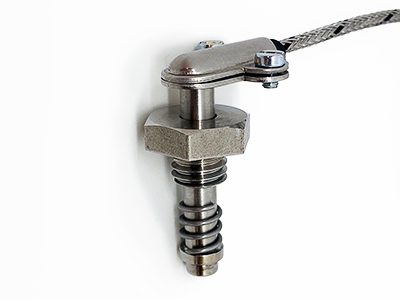
Overview resistance sensor / thermocouple
Temperature sensors at a glance: Thermocouples & resistance sensors
Temperature Sensors are essential for precise temperature measurements in industrial processes. The most common designs include thermocouples and resistance sensors - both with different operating principles and advantages.
Thermocouples generate a so-called thermoelectric voltage: a millivolt voltage that is created by the fixed connection of two different conductive metals. The temperature is recorded precisely at the tip of the sensor. A distinction is made between potential-free and potential-bound thermocouples - depending on whether the thermocouple wires are connected to the measuring tip (ground).
-
Potential-bound thermocouples offer the advantage of a particularly fast response time to temperature changes.
-
Potential-free thermocouples reliably prevent faults, as there is no earth connection to the control unit.
Resistance sensors function on the basis of the physical effect that the electrical resistance of metals changes when the temperature changes. As a rule, a Platinum sensor PT100 for use. One advantage: no special cable is required for the extension - standard copper cables are sufficient.
Typical designs of temperature sensors:
-
Sheath sensor
-
Bayonet sensor
-
Screw-in sensor
-
Angled Sensor
Precise temperature measurement with temperature sensors from HKE Tec
Temperature sensors play a central role in industrial measurement technology. They are used wherever temperature values need to be precisely recorded, monitored or controlled. A distinction is made between thermocouples and resistance thermometers - two tried and tested types of temperature sensor.
Thermocouples: robust and responsive
Thermocouples generate a millivolt voltage - also known as thermoelectric voltage - through a fixed conductive connection between two different metals. The temperature is recorded at a point in the sensor tip. A distinction is made between potential-free and potential-bound thermocouples.
In the case of potential-bound elements, the thermocouple wires are connected to the measuring tip, which enables a particularly fast response to temperature changes. Floating thermocouples, on the other hand, are electrically isolated from the measuring base - ideal if no interference must be transmitted via the ground.
Resistance thermometer: accurate & durable
A resistance thermometer - also known as a resistance sensor - works on the basis of temperature-dependent electrical resistance. Common sensors such as the Pt100 platinum sensor convert temperature changes into measurable resistance changes. In contrast to thermocouples, resistance thermometers do not require a special extension cable - standard copper cables are sufficient.
Designs of our temperature sensors
We offer various temperature sensor designs for industrial applications:
- Sheath sensor
- Bayonet sensor
- Screw-in sensor
- Angle sensor
You can find further information on our Overview page for temperature sensors.
Technical basics of resistance thermometers explained Wikipedia.
Sheath thermocouples consist of an outer sheath made of metal and, depending on the design, of 2 to 6 inner wires, the thermal material. The insulation of the inner wires consists of highly compressed magnesium oxide Mg0. Sheath thermocouples are used wherever extreme conditions prevail due to their chemical, mechanical and electrical stability. Due to the minimum bending radius (approx. 5 x outer diameter) sheath thermocouples can be fitted in places that are difficult to access.
NiCr-ni type K-200... + 1200 °c
Fe-CuNi Type J-200... + 800 °c
Fe-CuNi Type L-200... + 800 °c
- Thermocouples: Fe-CuNi type L, Fe-CuNi type J, NiCr-ni type K, cu-CuNi type T etc. also pt100 possible
- Diameter: 0, 15mm, 0, 25mm, 0.5 mm, 1.0 mm, 1, 5mm, 1, 6mm, 2.0 mm, 3.0 mm, 4.5 mm, 6.0 mm and 8.0 mm
- Installation length: Freely selectable from 50mm to 20,000 mm
- Connecting cable: PVC, silicone, PTFE or stainless steel with VA-sheath
- Temperature range: Up to 1250 °c depending on configuration
- End of connection: free ends or connection plugs according to requirements
- Accessories: Clamping Fitting, Thermoleitung, connection plug

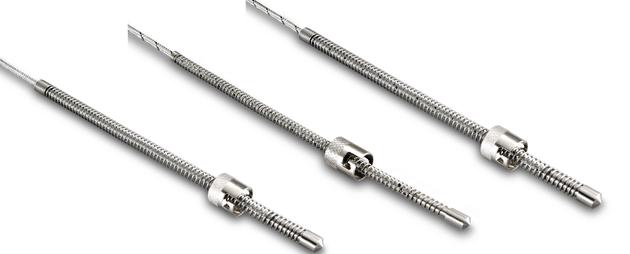
Due to the special measuring tip, the bayonet probes are particularly suitable for use in plane and pointed bores. The dimensionally stable compression spring ensures a constant contact pressure of the measuring tip in the borehole and also provides cable bend protection. Due to the adjustable bayonet lock, the installation length can be varied as required.
The bayonet sensors can be manufactured with all common sensors such as PT100, Pt500, Pt1000 as well as thermocouples of types K, J, L etc.
- Bayonet cap: Brass Nickel-plated diameter 12, 15 and 16mm Messpitze with 118 °
- Diameter 6mm or 8mm
- Installation Length 5 – 50mm
- Spring Length: 180mm alternative 250mm, special lengths on request
- End of connection: free ends or connection plugs depending on AnforderungTemperaturbereich:-60 °c... + 600 °c (depending on configuration)
- Accessories: Screw-in nipple with all common process threads
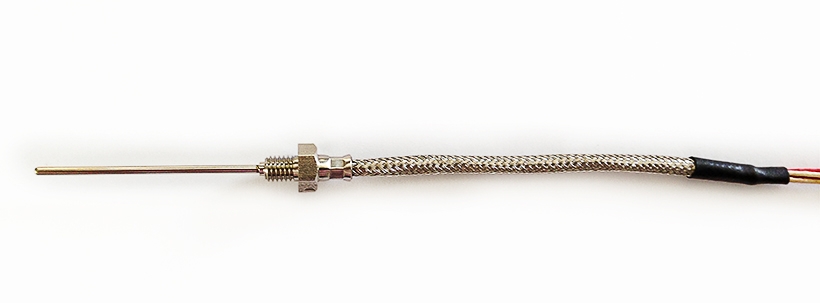
The cable probes with connecting cables are used for temperature measurement in liquid and gaseous media. The cable transition is strain relief and can be rolled if necessary to protect the measuring insert from moisture. Ends are assembled with any plug
Temperature range:-200 °c... + 650 °c (depending on configuration)
Accessories: Immersion Sleeves, clamping fittings or flanges
| Sensors: | PT100, Pt500, Pt1000, Ni1000, NTC, KTY or thermocouple type K, J and L |
| Installation Length: | freely selectable |
| Sleeve Diameter: | From 1.0... 8mm |
| Material: | Stainless steel, brass, PVC, Aluminium |
| Top form: | Depending on the application Spitz, plan or design |
| Power cord: | Depending on the application PVC, silicone, PTFE, metal braid or other |
| Connection: | Depending on demand, free |
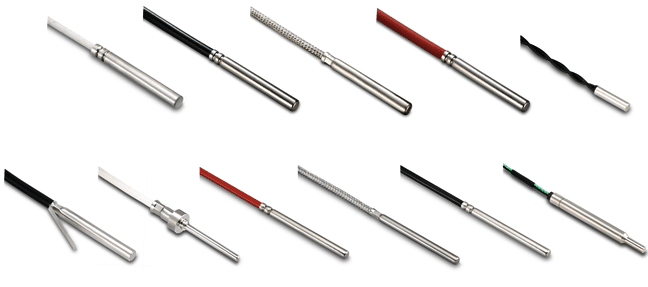
Product example
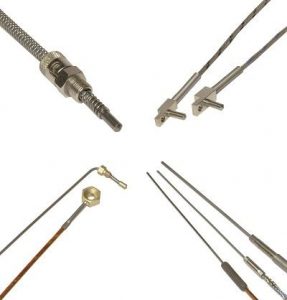
Individual designs according to customer requirements
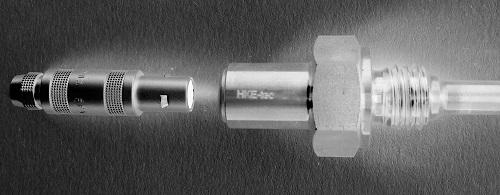
Screw-in sensor with Lemo plug
Screw-in nipple
Angle spring loaded